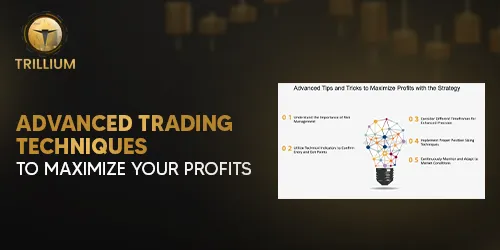
In a world of dynamic markets, buying and selling knowledge has become too simplistic to win the day. Advanced trading techniques must be deployed to handle the vicissitudes of volatility and mitigate risk so that accrual of profit in trading is regularized. Advanced techniques integrate technical analysis with market insights and risk management, enabling proper decision-making and sustainable returns.
Whether you are a newcomer or an experienced trader, putting proven trading strategies and following professional tips from traders into action would surely boost your performance in the market. Let’s investigate some of them that help improve your trading skills.
Leverage Algorithmic Trading
Algorithmic trading has completely transformed the game of executing trades. It relies on pre-programmed instructions based on parameters like price, volume, and timing. This makes the traders respond promptly and effectively. It enables traders to respond quickly and efficiently. Automated processes in algorithmic trading eliminate emotional decision-making, thus ensuring precision and consistency.
Key Insight: Algorithmic trading is the best for high-frequency trades when speed is of the essence. Platforms such as MetaTrader enable traders to design algorithms such as Expert Advisors (EA) that work best for their goals.
Mastering Technical Analysis
Technical analysis is the foundation of advanced trading. It helps predict the movement of prices using historical data, trends, and key indicators. Tools like moving averages, RSI, and Fibonacci retracement help in understanding market behavior and hence can identify entry and exit points at profitable times.
Application: For example, the combination of RSI with moving averages may confirm whether an instrument is overbought or oversold. Hence, it will decrease the probability of false signals.
Key Insight: Algorithmic trading is the best for high-frequency trades when speed is of the essence. Platforms such as MetaTrader enable traders to design algorithms such as Expert Advisors (EA) that work best for their goals.
Implement Robust Risk Management
Good risk management is the foundation of a good trade. Even the best-looking trade setup can fail if there is no plan in place to limit losses. Implementing stop-loss orders, a favorable risk-reward ratio of at least 1:2, and diversifying your portfolio are all good practices.
Limit your risk exposure to any given trade to 1-2% of your total trading capital. This will prevent massive losses on your portfolio.
Application: For example, the combination of RSI with moving averages may confirm whether an instrument is overbought or oversold. Hence, it will decrease the probability of false signals.
Capitalize on News-Based Trading
Market-moving news includes economic data releases, earnings reports, or geopolitical events. It creates some short-term trading opportunities. A trader, well-informed and quick enough to act, can seize some of the short-lived price movements caused by these events.
Example: Assume that a central bank suddenly surprises everyone by raising interest rates. Then traders can anticipate immediate currency market volatility and position themselves appropriately.
Day Trading and Scalping Techniques
Day trading and scalping are suitable for traders who respond well to fast-paced surroundings. Day trading is the activity of opening and closing all positions within a single trading session so that no overnight risks could occur. Scalping revolves around the execution of many small trades to take advantage of tiny price movements.
Pro Tip: Keep strict discipline and consider liquidity when using these strategies. It is high-liquidity assets that ensure smooth trades, hence tighter spreads.
Conclusion
You will need both advanced trading techniques and excellent risk management with a proper mindset to maximize the trading profits. You may now position yourself for consistent success in markets by using algorithms, mastering technical analysis, or even learning some sophisticated strategies, including options trading.
After all, learning to be a great trader is a continuous learning process. Continuously learn new things, adapt yourself with changing market conditions, and inculcate these professional trading tips within yourselves so you stay ahead of the pack. All you need is patience, persistence, and the proper strategy.
Actionable Tip: Maintain a trading journal to document decisions and to analyze mistakes for constant improvement. Mindfulness techniques like meditation can also be employed for focusing during turbulent times of market fluctuations.